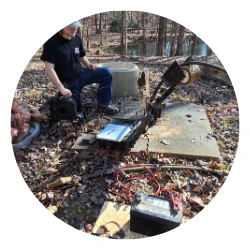
“Not sure what’s going on with your well? We use camera inspections to get a clear look inside, helping us find and fix problems before they get worse.”
A well is mostly invisible — the pump, the drop pipe and the casing all sit underground where problems hide until you're out of water. An inspection tells you the pump's condition, the well's yield and the casing's integrity before a small issue becomes a failure.
If your water gets dirty after a rain — or is dirty in general — that's a classic sign of surface water getting past the cap, the seal or a crack in the casing, and it's a good reason to get the well inspected. When something looks off, a downhole camera shows the casing, screen and water level directly instead of leaving it to guesswork.
Camera inspection is also how we find out whether a tired well can be saved. A cracked or deteriorated casing doesn't always mean drilling a new well — a well liner can often be set inside the existing casing to seal off bad sections and restore the well's integrity.
How the job goes
- 1
Wellhead and site review
We start above ground: cap and seal condition, casing height, drainage around the well, and distance from septic systems and other contamination sources.
- 2
Yield and performance testing
A timed flow test measures what the well actually delivers, and we evaluate the pump, tank and controls while the system runs under load.
- 3
Camera and inspection of the casing
If anything suggests casing damage or dirty water intrusion, the downhole camera goes in so we can see the casing, screen and joints directly. You get a copy of the video with your inspection.
- 4
Report you can use
Findings arrive in a written report covering yield, pump condition, equipment and anything the camera found — plus honest options, like a well liner, when repairs are needed.
Signs you need this service
- Your water gets dirty after a rain, or is dirty in general
- The well has unknown age or history
- Sediment, cloudiness or a drop in yield
- Suspected casing crack or surface water intrusion
- It's been years since anyone looked at the system
What's included
- Flow rate and drawdown/recovery testing
- Pump performance and electrical evaluation
- Pressure tank and control inspection
- Wellhead, cap and casing integrity check
- Downhole camera inspection of the casing as needed
- Well liner assessment when casing damage is found
- Written inspection report for your file
What affects the cost
No two wells are identical, so we quote after diagnosis — never before. These are the factors that move the price:
- Whether downhole camera inspection is included
- Whether a well liner evaluation is needed for casing damage
- Travel distance within the 40-mile service radius
- Depth of the well and time on site